When AI Invents Precedent: Supreme Court Sets Aside NCLT Order Over Hallucinated Citations
Updated: 09 Jul 2026 · For: AI and infrastructure founders shipping in India
Introduction
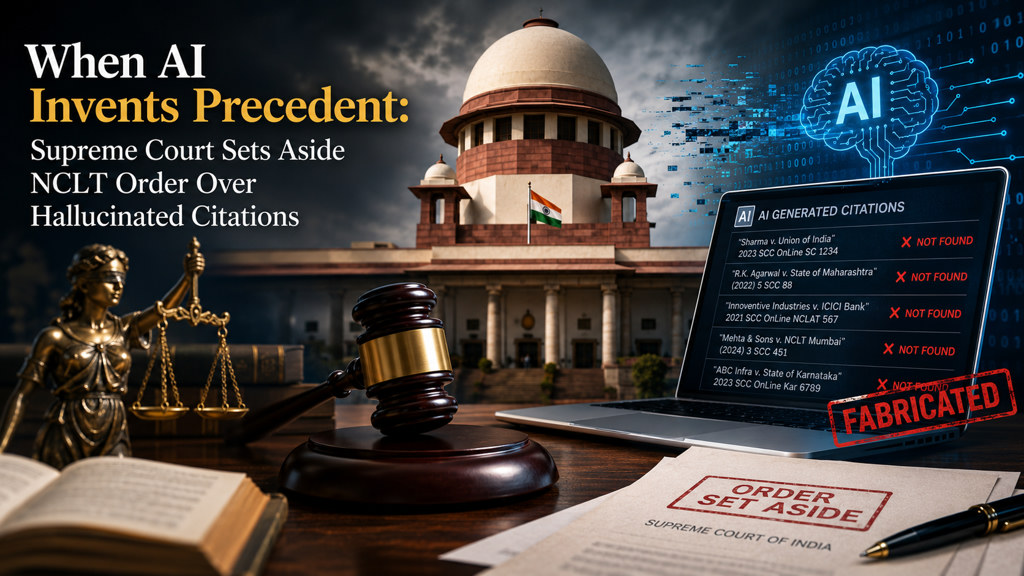
On 2 July 2026, a Supreme Court bench of Justices P.S. Narasimha and Alok Aradhe set aside admission and appellate orders in Pooja Ramesh Singh v. Jammu and Kashmir Bank Ltd. (2026 INSC 668) after finding that the National Company Law Tribunal and the National Company Law Appellate Tribunal had relied on six authorities that were wholly or partly fabricated. Some case names and citations did not exist; others were real judgments with invented paragraphs. The Court held that a decision tainted by even an iota of hallucinated material is no decision in the eyes of the law, that citing unverified AI-generated precedents is advocate misconduct, and directed the Bar Council of India to frame disciplinary norms. For GCs, law firms, legal-tech vendors and AI product teams, the ruling converts a growing pattern of tribunal recalls into a national zero-tolerance standard.
This piece explores the legal framework behind the judgment, how AI hallucinations enter adjudication, what verification duties now attach to counsel and in-house teams, and the operational controls legal departments and legal-tech builders should adopt before the next filing or diligence memo ships.
The Legal Framework: Zero Tolerance for Unverified AI Precedents
The dispute arose from a Section 7 Insolvency and Bankruptcy Code application by Jammu and Kashmir Bank against Essel Infraprojects Ltd., following default on a corporate guarantee tied to a Rs 200 crore credit facility. The Mumbai NCLT admitted the application on 28 August 2024; the NCLAT affirmed on 11 September 2025, reproducing the same precedent list. On appeal, the Supreme Court examined each cited authority and found multiple species of fabrication: wrong case names attached to genuine citations, non-existent citations, and quoted passages absent from the reports.
The Court's ratio is procedural and professional rather than merits-based. It restored the bank's application for a fresh hearing within two weeks and left the guarantee dispute open, but declared that unverified AI authorities cannot form the basis of adjudication. Citing fabricated precedents was characterised as misconduct under advocate discipline rules, with a specific direction to the Bar Council of India to constitute a committee and prescribe preventive norms and consequences. The judgment sits alongside earlier warnings, including Christian Louboutin SAS v. M/s The Shoe Boutique (Delhi High Court, 2023) on fictional case law from general-purpose chat tools, and the Supreme Court's own draft Regulations for Use of Artificial Intelligence in Courts, 2026, which define hallucination, require human verification before reliance, and treat AI output as advisory only.
For legal-tech operators, the message is not that AI is banned in research workflows. Indian retrieval-augmented tools that ground answers in licensed corpora reduce but do not eliminate risk. The decisive safeguard remains human verification in an authorised database before any citation reaches a court, tribunal, board paper, or customer-facing compliance output.
Assessing Emerging Tech Law Practices
| Practice | Legal Status | Compliance Recommendation |
|---|---|---|
| Pasting ChatGPT/Claude outputs into pleadings without SCC/Manupatra check | Misconduct risk; orders set aside if relied upon | Block as final step; require paralegal verification log |
| Legal-tech 'auto-drafting' that emits citations without retrieval grounding | High hallucination risk; vendor liability exposure | Contractual warrant of verified corpus; human sign-off gate |
| In-house litigation briefs using general LLMs for Indian precedent search | Not authoritative; inconsistent with SC zero-tolerance | Approved research stack only; partner review for all citations |
| Tribunal/bench 'own research' via unverified AI without audit trail | Serious adjudicatory lapse (per SC); institutional inquiry risk | Document research source, verifier, and report pin cites |
| RAG tools grounded in Indian judgment databases with pin-cite export | Lower risk if verifier opens primary source | Keep as assistive tier; never sole authority for filings |
| Diligence memos for investors citing AI-generated case summaries | Misrepresentation risk in deal docs if unverified | Separate 'draft AI summary' from 'counsel-verified' annex |
Striking a Balance and Adopting Best Practices
- Citation gate before filing: No citation leaves the firm until a human opens the primary report and confirms party name, citation string, and quoted paragraph.
- Tool tiering: Reserve general-purpose LLMs for structuring and summarising verified extracts; ban them as standalone precedent finders for Indian law.
- Vendor diligence: For legal-tech procurement, require retrieval grounding, audit logs, hallucination disclaimers, and indemnity for unverified citations in workflow outputs.
- In-house playbook: GC teams should publish an approved research stack, a two-person verification rule for tribunal filings, and a banned-tools list for external counsel.
- Incident response: If a fake citation is discovered post-filing, move immediately to correct the record and notify the forum; concealment amplifies misconduct findings.
- Product documentation: AI teams shipping research features to Indian users should surface verification UX, not confidence tone, and block one-click export to court-ready formats.
Conclusion
The Supreme Court has drawn a bright line: fluent AI output is not legal authority, and unverified citations are professional and institutional failure, not a technology accident. GCs, law firms and legal-tech builders that institutionalise verification, tool tiering and audit trails will treat this judgment as a compliance upgrade; those that do not will find the next recall order named in their workflow. Operational verification is now the minimum standard for any team touching Indian adjudication or counsel-grade outputs.
Frequently Asked Questions
What did the Supreme Court hold about AI-hallucinated citations?
In Pooja Ramesh Singh v. Jammu and Kashmir Bank Ltd. (2 July 2026), the Court set aside NCLT and NCLAT orders that relied on fabricated precedents, held that citing unverified AI-generated cases is advocate misconduct, and directed the Bar Council of India to frame disciplinary norms.
Does this ban lawyers from using AI for research?
No. The Court's concern is unverified reliance. AI may assist drafting and research, but every citation must be confirmed in an authorised report before it is filed or cited in adjudication.
Who is affected beyond advocates?
In-house GC teams, litigation vendors, legal-tech products used for Indian filings, and any enterprise publishing counsel-grade compliance outputs face reputational, disciplinary and set-aside risk if fabricated authorities enter their materials.
Disclaimer
It does not constitute legal advice or opinion, and it should not be relied upon by any person for any purpose, nor is it to be quoted or referred to in any public document or shown to, or filed with any government authority, agency, or other official body without our consent.
Source: Supreme Court judgment (LiveLaw) →
Topics: AI hallucinated citations India, Supreme Court NCLT fake precedents, legal tech verification India, advocate misconduct AI citations, Emerging Tech Law India, IBC Section 7 AI research, Bar Council AI rules
This publication is for general information only and does not constitute legal advice. Regulatory positions evolve; verify current notifications and obtain counsel before acting. © 2026 SB Tech Associates.